

The Gospel is not an invitation to perform for God.
It is an invitation to walk with God.
A continuation from Part One…
If we look closely at this strategy, we will see that central to God’s plan was the fact that humanity struggled to overcome the problem of disobedience, which resulted in ‘sin’ or separation from God. Equally important was that people had to offer a sacrifice to receive forgiveness and realign themselves through obedience. Even when they did this time after time, they still did not avoid disobedience and maintain a relationship with God. This caused the people of God untold suffering and loss.
I have arranged to set up the strategy below in picture form, making it easier to read. I find that the quote, ‘A picture is worth a thousand words,’ is true for me:
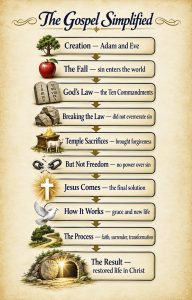
Flowchart Wording
Simplified wording for the chart.
- Creation — made for God’s purpose
- The Fall — sin enters the world
- God’s Law (Ten Commandments) — right and wrong made clear
- The Problem — the law reveals sin, but cannot remove it
- Temple Sacrifices — forgiveness is provided
- The Limitation — sin is covered, but hearts remain unchanged
- Jesus Comes — God’s final solution
- How It Works — grace, forgiveness, and new life
- The Response — faith, surrender, and obedience
- The Result — restored life in Christ
This flowchart shows the Gospel in simple form. It begins with creation, where humanity was made for God’s purpose. Then comes the fall, when sin entered the world and separated humanity from God’s design. God gave His law to make right and wrong clear, but the law could reveal sin without removing it. Temple sacrifices brought forgiveness, yet they could not change the human heart. That is why Jesus came as God’s final solution. Through Him comes grace, forgiveness, and new life. And as we respond in faith, surrender, and obedience, the result is a restored life in Christ
The only solution was to obey God’s law and build a strong relationship with God. Hence, the final piece of God’s strategy – the arrival of Jesus on this earth.
Jesus came to fulfill the law of Moses
According to the Gospel recordings, Jesus came to fulfill the law of Moses. His strategy was to live a life that exemplified God’s purpose for humanity in their stay on earth. He did this by teaching twelve men how to live on this earth through a system he often referred to as the Kingdom of God. Jesus taught these men not only verbally but also by practical example. Every word He spoke and action He performed demonstrated what it is like to live according to God’s purpose (or according to the kingdom principle/The Gospel). The commitment of twelve men was to teach others, who would teach others, and so on.
Considering all that had taken place in the Old Testament, you might be asking whether the arrival of Jesus was necessary. I’ll tell you why in the shortest possible way. God created humanity in His image and then saw them fail to maintain the purpose set before them. They paid the price of their failure in terms of God’s purpose and fell victim to a lawless living. The more they lived like this, the worse things became for them.
What did Moses do for God’s People
Moses gave God’s people guidelines for living in a way that would enable them to accomplish God’s purpose on earth. These were the Ten Commandments given by God to Moses on Mount Sinai. In addition, God gave them leaders who led them to a land of blessings. But even in this place, they failed and called out to God for a king to show them how to live on earth.
God Gives The People Kings
God gave them a king – in the end, 42 kings! Of these kings, only eight were Godly, and 34 were evil. After this event, the Jews fell into a depression, and this was their state when Jesus arrived. You don’t need to be a rocket scientist to see that their lives were in a mess. They lived as captives of a Roman emperor with a puppet king, Herod.
Jesus Arrives on Earth.
The birth of Jesus was not a normal human birth. This was because God placed a spirit into a virgin, Mary’s, womb. The male child grew with the Spirit of God inside His body. From an early age, Jesus demonstrated His power. At the age of twelve years, he turned water into wine at a wedding ceremony.
Many mistook Jesus’s saying that he was the Messiah, the person who was to free them from Roman rule. The Scribes and Pharisees accused Jesus of what they called blasphemy and had Him put to death. So, after three years of Godly living and teaching a powerful message of salvation, a few people followed His teachings, even to the point of death. The majority did not.
Those who did follow and practice His teachings became baptized as an outward expression of their belief and received the Spirit of Jesus hidden within them. They then began to witness Jesus’s fruit revealed through them in a newfound freedom to live God’s purpose on this earth. They began leading others toward salvation.
We shall continue with part three at our next meeting.
Blessing
Peter James